Delivered on October 5, 2026
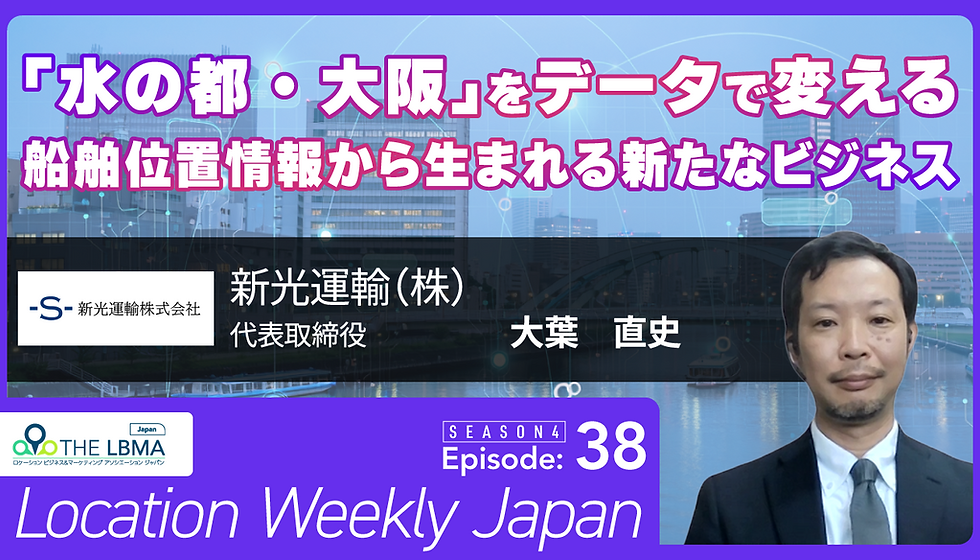
Transforming "Osaka, the City of Water" with data: New businesses born from ship location information.
Speakers:
Tadashi Ohba, Representative Director, Shinko Transport Co., Ltd.
Affiliation and position information is as of the time of distribution
Our guest this time is Mr. Ohba from Shinko Transport Co., Ltd., which handles the water transport of materials and equipment on Osaka's rivers and ports. We will hear about their "Boat Mark" initiative, which started with the operation management of their own vessels and now shares location information across multiple vessels, including sightseeing boats and cleaning boats, to promote safe river use. Furthermore, we will discuss the possibilities of new businesses that can arise from vessel location information, such as water taxis, tourism, and disaster prevention. Through the Ship Data Ideathon to be held on November 19th in collaboration with Kindai University and LBMA Japan, we will explore their vision for how to transform "Osaka, the City of Water" in five years.
====
Overview of Shinko Transport's Business and the Role of Water Transport in "Osaka, the Water City"
Shinko Transport Co., Ltd. is a shipping company that transports construction materials and heavy machinery by water in the port areas of Osaka Bay and the rivers of Osaka City. With a history of approximately 70 years, the company has supported urban infrastructure development while adapting its transported goods to the times.
Starting with cargo handling at ports, the company now primarily transports materials and equipment necessary for tsunami countermeasures in ports, bridge pier construction, and revetment reinforcement. Because residential areas in Osaka City are densely packed along the riverbanks, making land transport difficult, water transport using barges equipped with cranes is essential. In addition to material transport, the company also supports waterfront events from behind the scenes, such as providing boats as launching platforms for fireworks displays on rivers and at sea.
Background and Mechanism of the Ship Location Information Sharing System "Boat Mark"
The acquisition of location information, which began with the operation management of the company's own vessels, has evolved into sharing information aimed at ensuring the safety of river users.
Initially, we began collecting location information using smartphones to ensure our own vessels were operating on schedule. However, Osaka's rivers are used by a mix of construction vessels, tourist boats, cleaning boats, and recreational users such as SUP (stand-up paddleboarding) operators. The challenge was the risk of accidents and anxiety caused when large vessels carrying heavy materials navigated narrow waterways with poor visibility. Therefore, we proposed not only managing our own location but also sharing it with other operators. This initiative became "Boat Mark," a system that aggregates and verifies the location information of multiple operators.
Safety Measures for Small Vessels and Addressing Challenges Brought About by Location Information Visualization
Unlike large vessels, small vessels are not obligated to transmit location information, making voluntary location sharing key to accident prevention.
While large ocean-going vessels are required to disclose location information under international rules, small vessels are not and are treated as public resources accessible to anyone. In past tourist boat accidents, the lack of location information for certain vessels hindered situation assessment and initial rescue efforts, which was a significant challenge. Because much of the industry consists of small and medium-sized businesses and sole proprietors, and implementing uniform regulations takes time, privately-led mutual visibility is contributing to improved safety awareness and accident prevention.
Water Taxis and Disaster Response: New Business Areas Opened Up by Ship Location Information
Although ship location data is considered to have a smaller market size compared to human flow data, new value is being found in disaster prevention and the diversification of transportation.
While the market size is smaller than that of land-based human flow data, it is attracting attention as an operational base for new urban mobility such as water taxis. When land transportation is disrupted by earthquakes or large-scale disasters, the role of water transportation in replacing the transport of relief supplies and the evacuation of personnel is becoming increasingly important, and the need for it in disaster prevention is growing. By linking location data with urban functions, a business model that ensures demand and solves social problems is emerging.
Evolution of Water Transportation in Anticipation of the Rapid Increase in Inbound Tourism and the Opening of the Osaka-Kansai Expo and IR
Towards the revitalization of "Osaka, the City of Water," water transportation is evolving beyond a mere means of transportation into a high-value-added tourism experience.
With the increase in inbound tourists, the Osaka-Kansai Expo, and the opening of integrated resorts (IRs) all on the horizon, momentum is building for water access and the utilization of river spaces. As an increase in the number of services is expected, the development of location-based infrastructure to ensure safe navigation on narrow rivers is a matter of urgency. There is a growing movement to redefine water transport not merely as a means of transportation, but as a way to provide richer tourism experiences, including river views and special moments on board.
Co-creation with Kindai University and LBMA Japan: The Full Picture of the "Ship Data Ideathon"
Shinko Transport, in collaboration with LBMA Japan, a location-based business promotion organization, and Kindai University, will hold an event focused on future urban development utilizing ship data.
On November 19th, at "Kawanoeki Hachikenya" in Tenmabashi, Osaka, the "Ship Data Ideathon" will be held to explore new businesses using actual ship location data. In addition to businesses, students from Kindai University will also participate, engaging in concrete discussions from an industry-academia collaboration perspective on how to transform the future of "Osaka, the Water City" in five years. By aggregating and sharing data from multiple businesses, we aim to create innovative services and regional revitalization ideas unlike anything seen before.
Summary
The sharing of vessel location information, including Shinko Transport Co., Ltd.'s "Boat Mark," is a groundbreaking initiative that goes beyond the scope of company management, creating a safer river environment and new urban value.
Visualizing the location of small vessels holds diverse possibilities, not only for accident prevention and the creation of a safe navigation environment, but also for water taxis, alternative transportation during disasters, and tourism DX. Especially in Osaka, with its increasing inbound tourism and the upcoming opening of an integrated resort (IR), utilizing river data is key to maximizing its appeal as a "city of water."
Through multifaceted discussions via co-creation ideathons with LBMA Japan and Kindai University, it is expected that Osaka's river transportation and urban development will evolve into something richer and more sustainable in five years.