Guidelines for the use of location information and other "device location data"
一般社団法人LBMA Japanは、設立当初から、位置情報データが利用者の生活や行動に深く関わる性質を持つことを踏まえ、プライバシー保護と社会的有用性の両立に取り組んできました。2020年の共通ガイドライン発行時には、団体内に「共通ガイドライン委員会」(現・ロケーションプライバシー委員会)を設置しました。同委員会を中心に、利用者への情報周知や同意取得、データ提供先の管理などについて、法令の遵守に加えた自主的な対策を継続して検討し、ガイドラインの整備・改定を進めています。
2026年10月改定で強化した内容
2026年10月の改定(Ver4.1.0)では、総務省の「スマートフォン プライバシー セキュリティ イニシアティブ(SPSI)」への対応に加え、主に以下の事項に関する規定を強化しました。
* 利用者への情報開示と、取得・利用するデータの必要最小限化
* データ提供先のリスク評価および提供先の制限
* 提供先での再識別・他のデータとの突合を禁止する契約条項の整備
* 禁止セグメントの明文化と、重要施設等をセグメンテーションの対象から除外する方針の明示
これらは、移動履歴等を通じた個人の特定や、不適切な提供先へのデータ流通、プライバシーおよび安全保障上のリスクに対応するため、従来から進めてきた自主的なルール整備の一環です。
Guidelines for the use of location information and other "device location data"
August 2023 edition
Last updated: August 31, 2023
Background and overview of the guidelines
With the spread of various devices such as smartphones, the collection and utilization of location information and other data linked to devices is progressing. We have coined the name "device location data" for this location information and other data, and in October 2019, we launched LBMA Japan (which became a general incorporated association in February 2020) with companies that are developing businesses that utilize this data.
Device location data is collected from users' devices with their permission in applications, various web services, etc. The collected data has been used by national and local governments, research institutes, private companies, etc. for the purposes of disseminating information to make life more convenient, delivering discount coupons and advertisements, creating statistical data for market research and urban planning, developing infrastructure, and taking measures in the event of a disaster.
Basically, device location data alone cannot identify a specific individual, and to the extent that it cannot be easily matched with other information to identify a specific individual, it does not fall under "personal information" as defined by the Personal Information Protection Act. On the other hand, device location data has the nature of increasing the possibility that behavioral routes and visit histories can be visualized and specific individuals can be identified, depending on how it is accumulated and utilized.
Until now, businesses that utilize device location data have done so in accordance with their own rules, based on laws and regulations. However, in light of the recent social impact of data utilization, we believe that it is essential to establish industry-wide standards in order to promote healthy and sustainable data utilization, and have therefore created and announced common guidelines that members of LBMA Japan can use as indicators and standards. These guidelines were created after repeated discussions with member companies, legal professionals, lawyers, ethicists, etc., and consultations with the Personal Information Protection Commission Secretariat and related organizations.
*In accordance with the enforcement of the revised Personal Information Protection Act in April 2022, the status of location information data has been clarified, and these guidelines have been revised following review by relevant organizations.
Guideline Illustrated Explanation
When utilizing device location data such as location information,
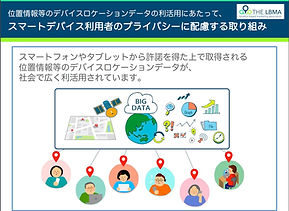
Scope of the Guidelines
This guideline applies to device location data obtained from smart devices.

Structure and positioning of the guidelines
The guidelines, which LBMA Japan member companies and their employees must follow when handling device location data, consist of "A. Principles" and "B. Regulations." (They are also publicly available.)

(Reference) Related laws and regulations and prerequisites for formulating the guidelines
LBMA Japan共通ガイドラインの策定過程において、以下の観点を前提としています。
1)国内の関連法規・ガイドラインの遵守
(参照先)
- 個人情報の保護に関する法律(https://www.ppc.go.jp/personalinfo/legal/)
- 電気通信事業法(https://www.soumu.go.jp/menu_hourei/d_shinjigyou.html)
- スマートフォン プライバシー セキュリティ イニシアティブ
(https://www.soumu.go.jp/main_content/001030684.pdf)
- 日本インタラクティブ広告協会(JIAA) 行動ターゲティング広告におけるガイドライン
(https://www.ppc.go.jp/files/pdf/190329_shiryou1-sankou2.pdf)
2)国際基準・プラットフォーム基準の参照
- 国連、OECDが定義する「基本的人権」や「プライバシー保護」の概念の踏襲
- GDPR(EU一般データ保護規則)、CCPA(カリフォルニア州 消費者プライバシー法)の動向
- Apple、Googleのポリシー・ガイドラインの踏襲
3)アカデミア観点の反映
- 大阪大学と電通の共同コンソーシアムである「データビジネスELSI研究会」によるレビュー
(Ethics(倫理)、Legal(法)、Social(社会)観点で、倫理学者・法学者・社会学者等)の見識を反映)
4)持続可能性のあるビジネス合理性の担保
- デバイスロケーションデータの利活用におけるイノベーション、課題解決への貢献や、国際競争力の強化
を促進すること
- LBMA Japan加盟各社の法務担当によるレビュー
About these guidelines
・These guidelines are intended to be operationalized by member companies of the LBMA Japan General Incorporated Association.
Each member company will strive to operate in accordance with these guidelines, and LBMA Japan, a general incorporated association, will establish a system to conduct audits to check whether operations are in accordance with the guidelines. For more information, please see the "Location Privacy Certification System" which provides the LP mark and LP consultants.
A. Principles and B. Regulations
By registering as a site member on this website (free of charge), you will be able to view and download the files from here .
*It is prohibited to publish the guidelines published on this website on any web media etc.
・If you have any comments about these guidelines, please contact us through our inquiry form . We will use your comments as a reference for future updates (please note that we may not always respond to all comments).
・The latest version of these guidelines is the August 2023 edition. Going forward, we will flexibly update them in response to amendments to laws and regulations, technological advances, changes in people's awareness and lifestyles, and opinions from various stakeholders, including consumers.